Best Franchise Opportunities in New York, New York

Get Your Free, Personalized Franchise Match Report

Answer a few questions. We’ll email you and follow up if you want help.

Step 11 / 6

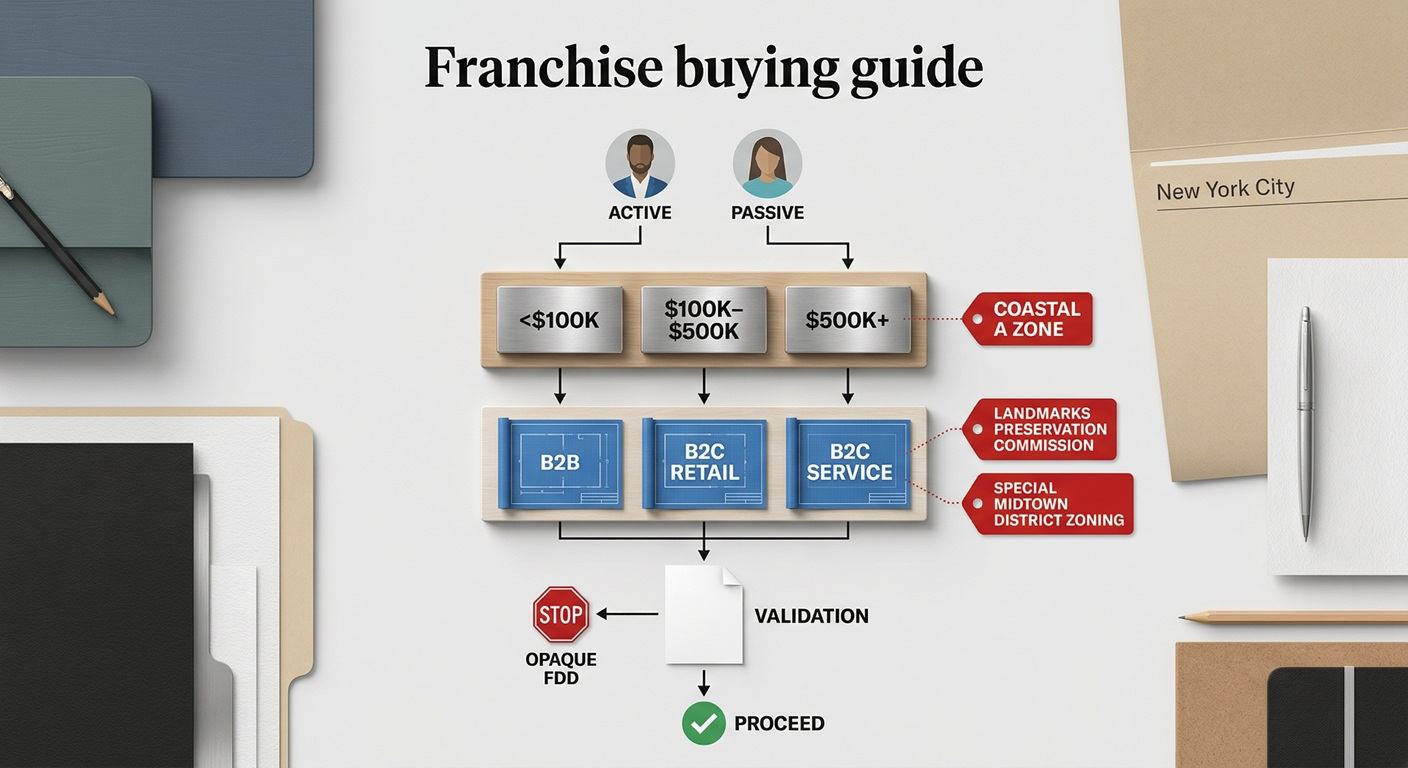
What kind of ownership style fits you best?

What’s your investment comfort range?

What kind of business fits you best?

How soon do you want to start?

What’s your weekly time capacity?

Where should we send your results?

Free to buyers. We may be compensated by franchise brands if you pursue an opportunity. No spam.

Book a free call to discuss 100s of opportunities we didn’t have space to display on this page.

Disclaimer & Affiliate Disclosure: This content is for informational purposes only and does not constitute financial, real estate, or legal advice. Franchise investments carry significant risk. We may receive referral fees from featured brands. Always independently verify local market data, review the Franchise Disclosure Document (FDD), and consult a licensed CPA or attorney before investing capital..
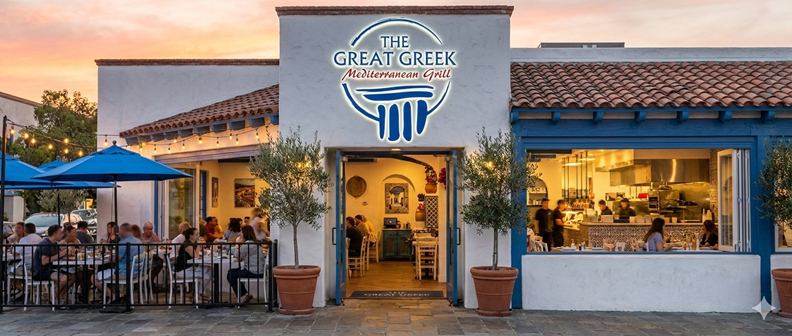
The Great Greek Mediterranean Grill

The Upper East Side requires navigating aggressive curb management strategies by the NYC Department of Transportation, where commercial delivery restrictions along Third Avenue force distributors into long-distance push-cart logistics.

Capturing the massive hydraulic pump of the 86th Street Subway Station, reported at 16.7 million annual riders, demands extreme operational precision during peak lunch hours. The local market leader, Yefsi Estiatorio at 1481 York Ave, maintains a strong reputation for authentic lamb and octopus, leaving a distinct market gap for high-velocity, digitally integrated Mediterranean options.

The Great Greek Mediterranean Grill is engineered to capture this underserved convenience sector. By deploying codified “Build Cards” and batch prep methodologies for complex recipes like Moussaka, the system facilitates the hiring of entry-level prep cooks while enforcing “Utensil Discipline” to manage high-risk allergens.

Operating in this environment requires budgeting an estimated $15,000 to $25,000 for custom wood or metal signage and $30,000 to $50,000 in legal fees to navigate the Madison Avenue Master Plan and secure a Certificate of Appropriateness from the Landmarks Preservation Commission.

Sources: nyc.gov, nyc.gov

Franchise overview
Marketing fund (in %)3%
Minimum cash required$142,500
Franchise fee$37,525
Who Has an AdvantageA COGS management wizard with experience in complex supply chains (lamb) and a restaurant background.
Who Is a Bad FitA manager unfamiliar with made-to-order food processes.
Request more information now
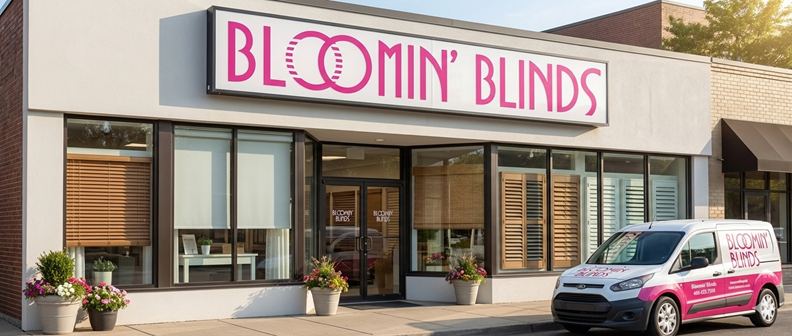
Bloomin' Blinds

Williamsburg presents a specialized operational environment where luxury residential density intersects with strict historic preservation mandates. The permanent redesign of Berry Street into a Bike Boulevard forces service vehicles onto gridlocked Kent or Bedford Avenues, increasing windshield time and complicating mobile logistics.

Operators must also manage Van Inventory Tetris to organize thousands of small parts, alongside maintaining ultrasonic cleaning tank fluid logistics to prevent cross-contamination. The Refinery at Domino adds a 460,000 square foot commercial footprint with approximately 3,000 daily workers requiring automated solar shading.

This expanding market features entrenched operators like M & A Design at 57 Pearl St, who maintain strong loyalty for depot-based ultrasonic cleaning. A distinct overflow demand exists for on-site, digital-first service among tech-heavy millennials.

Bloomin’ Blinds is engineered to capture this gap by deploying proprietary AI-driven software that optimizes technician routes to navigate Open Street barricades. Additionally, operators must factor in the New York City Landmarks Preservation Commission requirements prohibiting internally illuminated signs; custom fabrication and $2,000 in expediter soft costs directly spike start-up occupancy costs while adding 3-6 months to permitting.

Sources: nyc.gov, nyc.gov

Franchise overview
Marketing fund (in %)2%
Minimum cash required$25,000
Franchise fee$49,500
Who Has an AdvantageA charismatic owner-operator with strong project management skills, comfortable with fleet management.
Request more information now
About the page’s author, Thomas Jepsen
Franchise consultant & growth strategist
As seen in: Yahoo Finance

Master’s in Accounting, Strategy & Control. FBA-certified in franchises and FDD analysis. Raised institutional funding and completed a venture exit. Has advised aspiring franchisees on 20+ different business categories. Thomas helps aspiring franchisees evaluate brands objectively.

Thomas Jepsen
Rush Bowls

In New York, the Long Island City trade area presents intense logistical realities driven by commuter concentration and rigid municipal overlays. Court Square Subway Station processed 6,032,857 riders in 2024, funneling foot traffic alongside LaGuardia Community College’s 15,000 enrolled students.

Healthy Bowls and Juice Bar operates within a 1.2-mile radius, successfully fostering loyalty through high customization. However, their model leaves an uncaptured demographic seeking standardized, volume-based value during lunch peaks.

Local logistics require navigating Vernon Boulevard, a designated truck route with severe congestion. The Special Long Island City Mixed Use District (Article XI, Chapter 7) prohibits curb cuts and mandates 50% transparency on “Type 1” frontages, forcing hand-trucked deliveries from side streets.

Daily operations must balance blender and topping station speeds to prevent bottlenecks, while enforcing “Clean Spoon” protocols via squeeze bottles to prevent cross-contamination. Navigating this, the “Blender Wall” pivot-point layout is engineered to maximize throughput within a 500-1,200 sq.

ft. footprint, lowering rent expense.

Franchise overview
Marketing fund (in %)2%
Minimum cash required$57,500
Franchise fee$39,000
Who Has an AdvantageThe health-conscious marketer who is familiar with guerrilla marketing.
Who Is a Bad FitThe supply chain novice.
Request more information now
Magnolia Soap

The Midtown East street grid is heavily pressurized by local infrastructure. Grand Central Terminal acts as the primary demand generator, where the recent Grand Central Madison expansion increased LIRR capacity by 41%.

This injects a predictable, high-volume flow of affluent commuters ideal for a grab-and-go personal care model. Extraordinary NY currently captures high transaction values through a curated gallery of unique items.

However, their focus on sporadic novelty creates a quantifiable gap for standardized, daily-use consumables. Magnolia Soap captures this recurring revenue; a library of proprietary plant-based recipes allows rapid customization to local trends, maintaining product consistency.

Operationally, navigating this density requires precision-timed raw material deliveries to avoid the strict 3-hour commercial loading cap enforced from 7 AM to 6 PM. Franchisees must also budget for a 200-300% CapEx increase on custom-fabricated signage to pass Daylight Evaluation compliance because the Special Midtown District Zoning Resolution bans standard illuminated box signs below 10 feet.

Internally, operators must manage 4-6 week Curing Rack pipelines and comply with NFPA 30 codes for Category 4 Flammable Liquids.

Franchise overview
Marketing fund (in %)1%
Minimum cash required$52,500
Franchise fee$60,000
Request more information now
Franchise owner success story
Client Success Story
“Thomas helped me find the franchise that actually fit my goals.”
— Jeff, Franchise Owner
Read case study
Paul Davis Emergency Services

The Upper West Side’s pre-war housing stock, anchored by the 100,000-plus seasonal visitors at Riverside Park, presents a concentrated operational environment for Paul Davis. The entrenched incumbent, 24 SERV LLC, effectively commands the immediate water removal segment, leaving a distinct service gap for clients requiring transparent, digital-first claims processing.

When projecting Day-1 CapEx, you must factor in the Special Enhanced Commercial District 2 (EC-2) regulations along Columbus and Amsterdam Avenues. This zoning overlay mandates active retail frontage, driving occupancy costs 20-30% higher than standard flex space.

Additionally, compliance with the Landmarks Preservation Commission is estimated to add $15,000 to $25,000 to initial signage and facade requirements. Logistically, the local “Smart Curbs” pilot has eliminated roughly 80 parking spots, creating a strict staging hurdle for equipment offloading.

Field operators must prioritize mastering precise Xactimate sketching and executing 3D ‘Digital Twin’ site scans to validate line-of-sight coverage. To streamline these complex local logistics, the brand’s integration of RMS and MICA software is designed to support real-time data syncing, reducing overall payment friction.

Franchise overview
Marketing fund (in %)2%
Minimum cash required$20,000
Franchise fee$29,500
Who Has an AdvantageThe "Empire Builder" with high-ticket experience.
Who Is a Bad FitThe 9-5er who is unfamiliar with the hurdles of accounts receivable lag.
Request more information now

Factors to consider

Retailers will face upfront permit hurdles via the City Environmental Quality Review (CEQR), which exacts scheduled fees of $5.00 to $12.00 per square foot due at permit filing, while mobile operators will need to account for routing delays and suppressed labor mobility from the Hudson Tunnel Project, an active civil construction zone slated to block the New Jersey to Manhattan corridor through 2038.

Hiring is competitive here; macro-economic anchors like the Amazon JFK8 Fulfillment Center offer entry-level packages over $21.50 per hour, which puts pressure on local recruitment and creates retention hurdles for service-tier staffing. Fixed-location builds in a Coastal A Zone may trigger structural mitigation requirements, so operators will need to verify compliance and insurance premiums with the local planning department.

Additionally, per the 2019 filings for Local Law 97, commercial footprints exceeding 25,000 square feet face a scheduled $268 per metric ton penalty for excess carbon emissions; because this data is older than 12 months, it requires a franchisee status update from the Department of Buildings prior to capital allocation.

Local operator insights

During recent calls with boutique fitness and sit-down dining local operators, they expressed optimism over the City of Yes for Economic Opportunity, which unlocks previously restricted real estate for as-of-right deployment. Furthermore, these franchisees are thrilled that the Interborough Express (IBX) will generate high-volume pedestrian transfer hubs in the outer boroughs.

However, they shared significant operational friction regarding the Department of Buildings (DOB), where administrative gridlock is extending holding costs on idle leases. Consequently, operators are increasingly retaining highly compensated permit expediters to navigate the plan desk delays and secure timely mechanical approvals.

Our Evaluation Methodology

  • 1
    Franchisor Vetting & Financial Due Diligence

    NYC's lively pulse demands solid franchises. FDD review & litigation checks were key. We linked franchise stability to NYC's economic drivers, requiring validated Item 19 financial statements.

  • 2
    Local Market Feasibility & Demographic Alignment

    We selected franchises whose target demo mirrored NYC's resident population concentration, age (36 avg), & median household unit earnings ($70k+).

Expert Reviewer(s)

Poll Morefield
Poll Morefield
Franchise Lawyer

15+ years of experience with franchise law.

Fred M. Wolfe
Fred M. Wolfe
CPA

10+ years experience as a CPA.

Earnings disclaimer

If any earnings claims are made for a prospective franchisor, those are verified against the Item 19 FDD version specified.

Disclaimer: The information above is not an offer to sell or a solicitation of an offer to buy a franchise. Offers are made only through the delivery of a FDD. Consult a lawyer when reviewing an FDD. Investment ranges/requirements sourced from FDDs.

Book Free Franchise Consultation