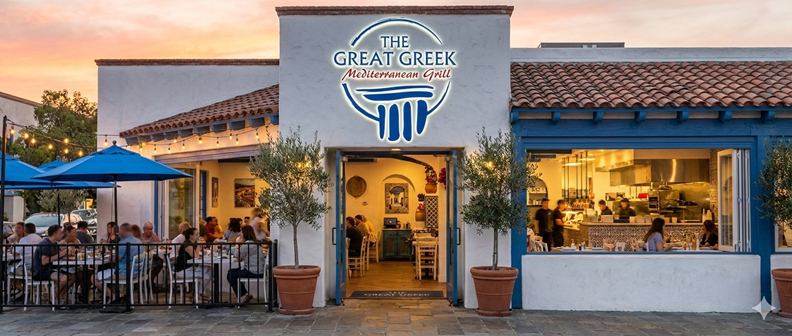
The Great Greek Mediterranean Grill
Operating The Great Greek Mediterranean Grill in Northeast Minneapolis involves enduring extreme winter logistics along Central Avenue, where Snow Emergency rules mandate a total loss of street parking during municipal plowing operations. The neighborhood is anchored by the University of Minnesota Twin Cities, housing an estimated 56,666 students who require rapid, accessible dining options. Emily's Lebanese Deli at 641 University Ave NE serves as the dominant legacy incumbent, maintaining a cult status since the 1970s for their high-quality tabbouleh. Yet, their traditional operational style creates an unfulfilled demand for digital-first convenience, integrated app transactions, and highly reliable order processing. Back-of-house realities require enforcing strict utensil discipline and station segregation to prevent cross-contamination of high-risk allergens, while also adhering to frequent grease interceptor maintenance to prevent odors that deter customers. Furthermore, operators should verify how local Snow Emergency rules may impact winter cash flow during legal due diligence; restricted street access yields an estimated 20% to 40% daily revenue loss, with unaware customers facing $200 towing risks. To streamline these intensive kitchen protocols, the brand utilizes codified batch prep methodologies, which is engineered to maintain consistent recipe execution using entry-level prep cooks.
| Franchise overview |
| Marketing fund (in %) | 3% |
| Minimum cash required | $142,500 |
| Franchise fee | $37,525 |
| Who Has an Advantage | A COGS management wizard with experience in complex supply chains (lamb) and a restaurant background. |
| Who Is a Bad Fit | A manager unfamiliar with made-to-order food processes. |

Request more information now
Camp Bow Wow
The Uptown territory requires Camp Bow Wow operators to manage a highly regulated physical environment supported by the 4,800 employees at Abbott Northwestern Hospital. The incumbent, City Paws Pet Club at 300 S. 2nd St, effectively commands the premium visual luxury segment. This establishes an expansion opportunity to capture an underserved niche demanding standardized dog-to-human safety ratios and certified pack management. Logistically, the facility must navigate the massive Phase 2 Hennepin Avenue Reconstruction, which severely detours sidewalks and limits direct access. To maintain operational efficiency during this two-year road closure, the franchise uses Tableau integration to predict demand trends and automate vaccine compliance checks, optimizing capacity utilization. Inside the facility, the operational model is structured to mitigate staff compassion fatigue and execute rapid isolation protocols for kennel cough containment. Operators should verify the Minneapolis City Council’s Animal Boarding Zoning Amendment during legal due diligence; while it permits commercial district operations, the required acoustic damping to prevent noise complaints can increase standard build-out costs by an estimated 15 to 20 percent.
| Franchise overview |
| Marketing fund (in %) | 2% |
| Minimum cash required | $285,000 |
| Franchise fee | $50,000 |
Request more information now
About the page’s author, Thomas Jepsen
Franchise consultant & growth strategist
Master’s in Accounting, Strategy & Control. FBA-certified in franchises and FDD analysis. Raised institutional funding and completed a venture exit. Has advised aspiring franchisees on 20+ different business categories. Thomas helps aspiring franchisees evaluate brands objectively.

Magnolia Soap
Launching Magnolia Soap in Downtown East involves navigating an environment shaped by massive infrastructure and rapid residential density. The local census tract has reportedly quadrupled in population, providing a built-in customer base. However, proximity to US Bank Stadium introduces severe logistical hurdles; game day closures completely sever access, shutting down streets like Chicago Ave and 4th St for 24 hours during events. Operators should verify how the US Bank Stadium Event Zone and Large Block Event Permits impact access during due diligence, as security perimeters often require special permits and restrict customer flow. This dynamic environment requires operators to balance the internal "Maker" production workflow with immediate customer service demands to prevent interrupted soap batches. Management must also mitigate staff olfactory fatigue through high-turnover HVAC ventilation and frequent fresh air breaks. While successful local independent operators exist within the broader retail landscape, a specific market gap remains for interactive, experiential retail. Magnolia Soap captures this demand by deploying the "Party-in-a-Box" protocol, utilizing store real estate for event hosting during off-peak hours to drive paid customer acquisition.
| Franchise overview |
| Marketing fund (in %) | 1% |
| Minimum cash required | $52,500 |
| Franchise fee | $60,000 |
Request more information now
USA Insulation
Driven by a climate characterized by extreme cold and destructive ice dams, the Downtown West trade area features inelastic demand for structural weatherization. Highly successful incumbents like Century Insulation and Lewis Insulation currently absorb significant market share. USA Insulation functions as a market complement by capturing overflow demand for specialized retrofits, facilitating an in-home sales process that utilizes thermal imaging tablets to calculate the 'R-Value Gap' and support high-average tickets. Executing this mobile service model downtown requires navigating severe winter conditions where snow and ice continuously complicate site access and fleet logistics. Operators should meticulously verify how municipal truck bans, which prohibit vehicles over 26,000 lbs from street parking unless actively loading and carry a reported $250 fine, may impact daily operations during legal due diligence. On the job site, crews must manage strict technical requirements, including the immediate application of acetone-based solvents to dissolve accidental overspray from vinyl siding, as hardened Aminoplast resin requires expensive substrate replacement. Simultaneously, teams must enforce rigorous gun cleaning rituals to protect sensitive internal components within the proprietary injection equipment.
| Franchise overview |
| Marketing fund (in %) | 2% |
| Minimum cash required | $70,000 |
| Franchise fee | $50,000 |
| Who Has an Advantage | A sales team builder with technical/construction material experience. |
| Who Is a Bad Fit | The operationally-passive desk lover who doesn't want to get behind the wheel. |
Request more information now
Rush Bowls
The Linden Hills commercial node experiences significant seasonal traffic driven by the Minneapolis Chain of Lakes Regional Park, which reports millions of annual visits and funnels athletic consumers directly into the neighborhood. Premium organic brands like Vibe Organic Juice Bar at 4720 Excelsior Boulevard successfully command the purity-focused demographic. Their highly customized, labor-intensive preparation methods leave a measurable market gap for a high-velocity, fast-casual health concept tailored to time-constrained patrons. Rush Bowls is engineered specifically to capture this overflow through streamlined blender efficiency and a "No Hoods, No Ovens" architecture that drastically reduces build-out capital expenditures. During the site selection phase, operators must evaluate the Linden Hills Overlay District guidelines, which explicitly prohibit backlit and pole signage, often necessitating custom gooseneck illumination that can inflate signage costs. Daily operations are currently complicated by ongoing streetscape construction near Upton and Sheridan, where severe parking deficits disrupt delivery schedules. To maintain brand standards, franchisees must constantly monitor high-RPM blender drive sockets for wear and rigorously inspect all IQF fruit deliveries for cold-chain thaw-refreeze clumping.
| Franchise overview |
| Marketing fund (in %) | 2% |
| Minimum cash required | $57,500 |
| Franchise fee | $39,000 |
| Who Has an Advantage | The health-conscious marketer who is familiar with guerrilla marketing. |
| Who Is a Bad Fit | The supply chain novice. |
Request more information now
Paul Davis Emergency Services
Executing a Paul Davis restoration operation in this territory requires navigating the City of Minneapolis's alley snow removal policy, where adjacent property owners are responsible for clearing residential alleys. During heavy winter weather, these routes can become impassable for box trucks and van fleets, severely complicating emergency site access. Operators must also manage strict Category 3 sewage decontamination protocols to protect staff health, alongside maintaining a rigorous 24/7 on-call roster to sustain vendor scores. At the permitting stage, converting a retail space into a restoration depot with commercial laundry triggers a Metropolitan Council Sewer Availability Charge, introducing a potential $10,000 to $50,000 capital expenditure fee based on wastewater capacity units. The local mitigation market features highly proficient incumbents like Rapid Restoration, which excels in seamless insurance direct billing. However, a specific demand gap exists for operators offering a consolidated schedule that seamlessly bridges the mitigation and reconstruction phases. Supported by high property values near Lake Harriet, operators utilize RMS and MICA software integrations with Xactimate to generate audit-proof estimates, facilitating streamlined claims cycles for premium properties.
| Franchise overview |
| Marketing fund (in %) | 2% |
| Minimum cash required | $20,000 |
| Franchise fee | $29,500 |
| Who Has an Advantage | The "Empire Builder" with high-ticket experience. |
| Who Is a Bad Fit | The 9-5er who is unfamiliar with the hurdles of accounts receivable lag. |
Request more information nowFacility conversions require strict utility audits under the MCES SAC Determination Rules, which recalculate theoretical wastewater capacity upon any change of property use. This triggers the Sewer Availability Charge (SAC), a fixed $2,485 upfront cost per 274 gallons of maximum potential daily capacity, due before a business license is issued. These rules represent key variables for your legal and accounting team to review during due diligence, as restaurants face one SAC unit per 300 gross square feet. For physical routing, the 2025–2030 Capital Improvement Plan schedules extensive work on the Hennepin Avenue Bridge, ensuring restricted access and lane closures across intra-city corridors. Hiring demands active recruitment, as macro-economic anchors like Target Corporation increase local wage competition well above the statutory minimum wage of $15.57. Fixed-location retail and QSR models will need highly accurate seating charts to manage theoretical utility assessments, while mobile service operators must shift dispatch zones to bypass the prolonged river-crossing construction.